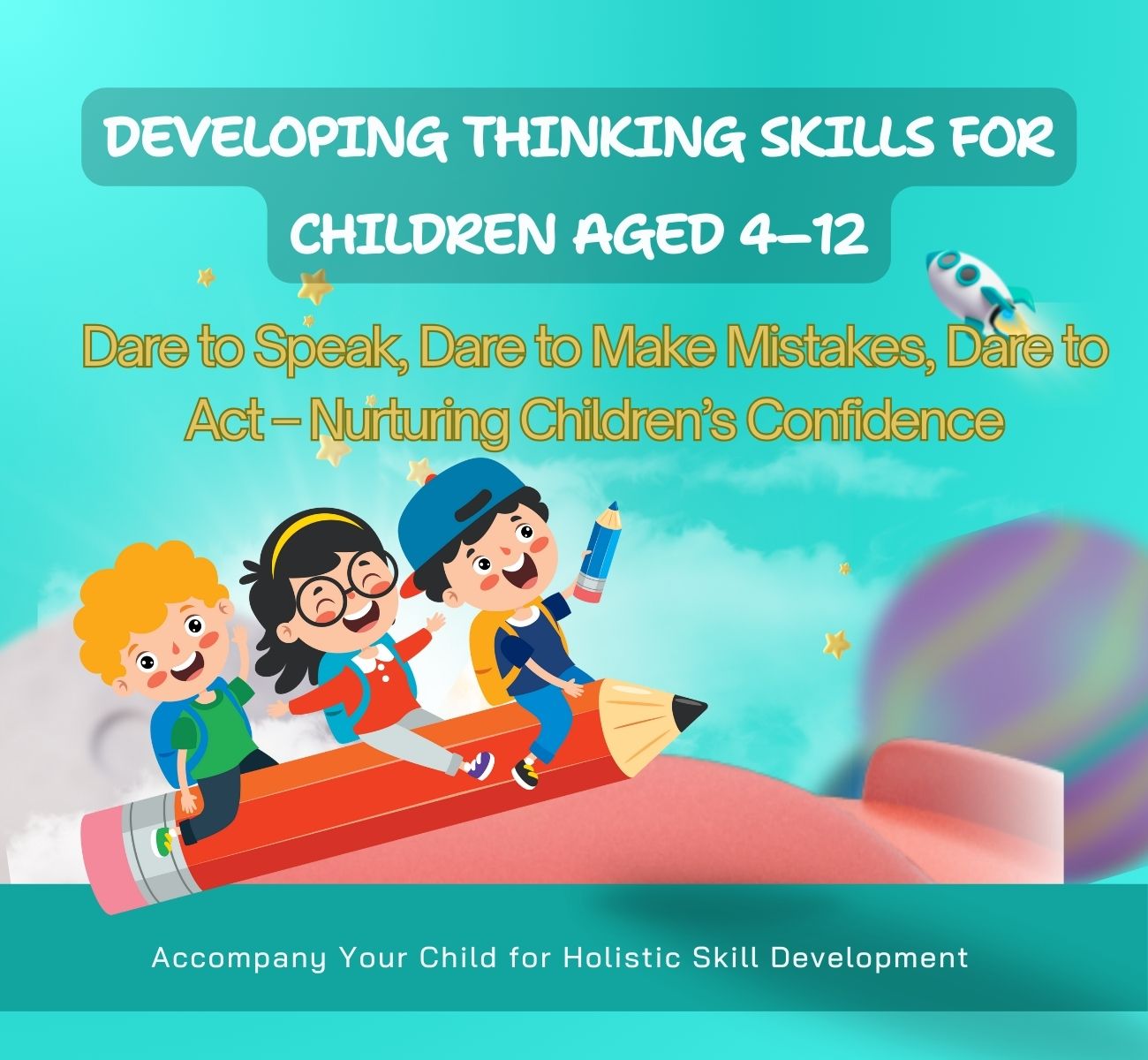
Did you know… the feeling of “I can do it” in a child’s mind is like a staircase leading to success?
If that staircase is strong, the child will boldly take the next step even without knowing what awaits. But if it is weak, the child may hesitate, feel afraid, and remain stuck. This staircase represents self-efficacy (Albert Bandura, 1977) – the belief in one’s own ability. When children believe they can learn, they are more willing to try, make mistakes, and learn from them instead of giving up.

Why are children afraid of making mistakes and losing confidence?
Children are not naturally born with a fear of mistakes. This fear often comes from experiences of being laughed at, compared to others, or scolded for giving the wrong answer. Over time, they develop the thought: “I’m not good → I shouldn’t even try.”
In contrast, Carol Dweck (2006) showed that when children adopt a growth mindset, they believe their abilities can improve through effort and practice. This perspective helps them see mistakes as part of the learning journey rather than proof of being “not smart enough.”

What can parents and teachers do to nurture learning confidence?
1. Normalize mistakes
When a child answers incorrectly, say: “It’s okay to be wrong, let’s try another way” instead of “Why did you get it wrong?” Positive language helps children avoid linking mistakes to their self-worth.
2. Recognize effort, not just results
Praise the process: “You really thought carefully before answering” rather than only “That’s correct.” This reinforces the idea that success comes from effort.
3. Create a safe environment to try and fail
Group activities, learning games, or role-play situations provide opportunities for children to share ideas without fear of being judged.

4. Share your own stories of failure
When parents or teachers talk about times they made mistakes but learned from them, children see that mistakes are normal—even for adults.
Mistakes are not the “end of the sentence” but a “comma” in the learning journey
When children dare to speak, dare to make mistakes, and dare to act, they are climbing their own staircase step by step. And every step, whether right or wrong, is a valuable part of that journey.
References
Bandura, A. (1977). Self-efficacy: toward a unifying theory of behavioral change. Psychological Review, 84(2), 191.
Dweck, C. S. (2006). Mindset: The new psychology of success. Random House.